
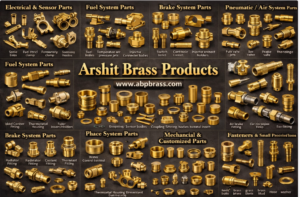
Brass Components Manufacturer In India.
Brass Components Manufacturing Process
1. Raw Material Selection
Brass components manufacturing starts with selecting high-quality brass raw material such as brass rods, bars, or billets. Different brass grades are selected according to product application and customer requirements.
2. Cutting Process
The brass raw material is cut into required sizes using cutting or band saw machines. Proper cutting helps reduce material wastage and improves machining accuracy.
3. Forging Process
Some brass parts require forging to increase strength and durability. Heated brass material is shaped using forging dies and press machines.
4. CNC Machining Process
The cut material is machined on CNC and automatic turning machines to achieve accurate dimensions, shapes, and profiles. Operations like turning, drilling, and boring are performed in this stage.
5. Threading Process
Internal and external threads are created using taps, dies, or CNC threading tools. Thread accuracy is checked using standard thread gauges.
6. Drilling and Tapping
Additional holes and threaded sections are produced through drilling and tapping operations. These processes are important for assembly and fitting applications.
7. Deburring Process
Sharp edges and unwanted burrs created during machining are removed manually or using vibro finishing machines. This improves product safety and surface quality.
8. Surface Finishing
Different surface finishes like natural, nickel plating, chrome plating, or tin plating are applied to improve appearance and corrosion resistance.
9. Quality Inspection
Each brass component is inspected using precision measuring instruments to ensure dimensions, threads, and surface finish meet customer specifications.
10. Cleaning Process
Finished components are cleaned to remove oil, dust, and machining particles. Proper cleaning improves product appearance and prevents corrosion.
11. Assembly Process
If required, additional parts like O-rings, washers, or screws are assembled with the brass components before final packing.
12. Packing Process
The finished products are packed using poly bags, boxes, and export cartons to protect them from damage during transportation and storage.
13. Dispatch and Export
After final inspection and packing, the brass components are dispatched to domestic and international customers with required export documents and test reports.
Top 10 Uses of Brass Components in Industry
Brass components are widely used in different industries because of their excellent strength, corrosion resistance, electrical conductivity, and precision machining properties. High-quality brass parts are essential for reliable industrial performance and long service life.
1. Electrical Industry
Brass components are extensively used in electrical applications such as terminals, connectors, neutral links, and switchgear parts due to their excellent electrical conductivity.
2. Plumbing Industry
Brass fittings, valves, and connectors are commonly used in plumbing systems because brass offers high corrosion resistance and leak-proof performance.
3. Automotive Industry
The automotive sector uses brass components in fuel systems, sensors, battery terminals, and precision machined parts for durability and reliability.
4. Electronics Industry
Brass precision parts are used in electronic devices, PCB terminals, connectors, and communication equipment because of their excellent conductivity and dimensional accuracy.
5. Gas and Oil Industry
Brass valves, adapters, and fittings are widely used in gas and oil applications due to their strength, pressure resistance, and safety performance.
6. Telecommunications Industry
Telecommunication equipment uses brass connectors and precision turned parts for stable signal transmission and long-lasting performance.
7. Industrial Machinery
Many industrial machines use brass bushes, inserts, spacers, and fasteners because brass provides smooth operation and wear resistance.
8. Construction Industry
Brass hardware, sanitary fittings, and architectural components are used in construction projects for their durability and attractive finish.
9. Medical Equipment
Brass components are also used in certain medical instruments and equipment where precision machining and corrosion resistance are important.
10. Renewable Energy Sector
Solar and renewable energy industries use brass electrical connectors and precision components for efficient power transmission and outdoor durability.
Conclusion
Brass components play an important role in modern industries because of their versatility, strength, corrosion resistance, and precision performance. Their wide range of industrial applications continues to increase global demand for high-quality brass precision parts.